
If your lawn mower won’t start, the most likely culprits are stale fuel, a dirty spark plug, a clogged carburetor, or a blocked air filter. In most cases, you can diagnose and fix the problem yourself in under an hour without spending a dime at a repair shop. This guide walks you through every common cause, what it looks like in practice, and exactly what to do about it.
Whether you own a push mower, a self-propelled gas model, a riding mower, or a battery-powered unit, the troubleshooting logic is largely the same. Let’s start from the most common issues and work our way down.
Before You Touch Anything: A 30-Second Safety Check
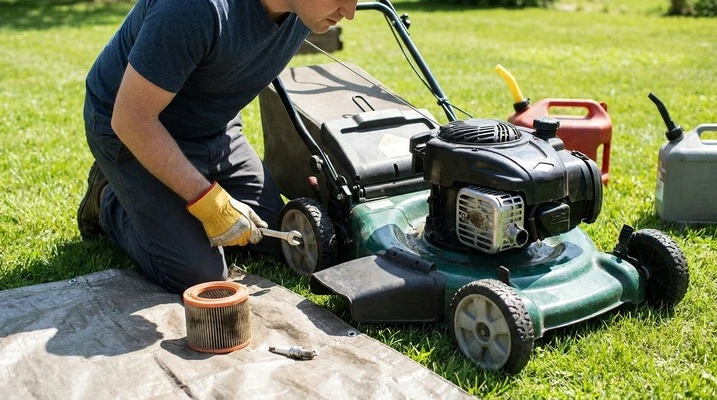
Before diving into any inspection, always disconnect the spark plug wire if you plan to flip the mower, reach under the deck, or work near the blade. On riding mowers, remove the ignition key and engage the parking brake. These are non-negotiable steps, not suggestions.
Also, check this quick list before assuming something is broken:
Is the fuel tank empty? Is the bail lever (the handlebar safety bar) being held down firmly while pulling the cord? Is the blade engagement lever in the “off” position? Is the oil level dangerously low? These four things alone account for a surprisingly large number of “my mower won’t start” calls.
Cause 1: Stale or Contaminated Fuel
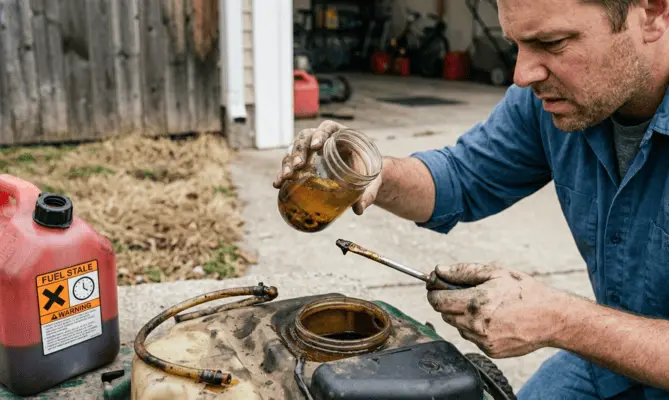
This is the single most common reason a lawn mower refuses to fire up, especially at the start of mowing season. Gasoline has a shelf life. After sitting in a tank or fuel can for 30 to 60 days, it begins to break down chemically. The volatile compounds that make gas combustible start to evaporate, leaving behind a thick, varnish-like residue that coats the inside of your carburetor and fuel lines.
Modern gasoline blended with ethanol is particularly bad in this regard. Ethanol absorbs moisture from the air, and when that water-contaminated mix sits in a small engine over winter, it gums up almost everything it touches.
What it looks like: The engine cranks but never catches. You might smell fuel, but nothing fires. Sometimes it will start for a second and immediately die.
How to fix it: Use a fuel siphon pump to remove all the old gasoline from the tank. Dispose of it properly at a local recycling center or auto parts store. Refill with fresh, clean gasoline. If the old fuel has been sitting for more than a season, follow up with a carburetor cleaning as described in Cause 4 below. Going forward, add a quality fuel stabilizer like STA-BIL to any gas that won’t be used within 30 days. This keeps fuel fresh for up to two years.
Cause 2: A Fouled or Worn Spark Plug
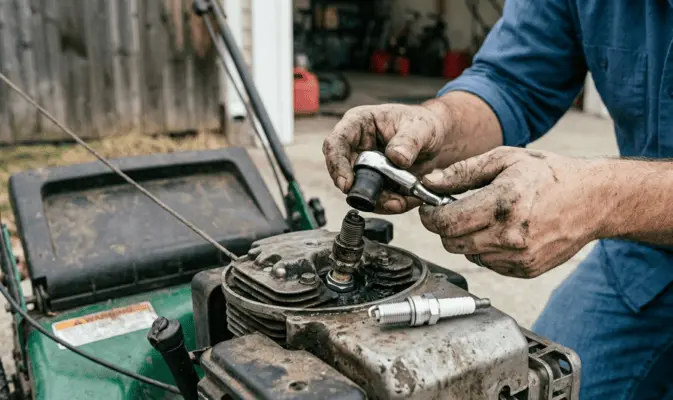
The spark plug is responsible for igniting the air-fuel mixture inside the engine cylinder. When it becomes fouled with carbon deposits, coated in oil, cracked, or simply worn out from seasons of use, it either produces a weak spark or no spark at all. Without a reliable ignition source, the engine cannot fire.
What it looks like: The engine cranks normally, but never starts. You might hear the engine “trying” but nothing catches. On older plugs, you may notice the electrode tip is rounded, corroded, or caked in dark residue.
How to fix it: Locate the spark plug on the front or side of the engine. Use a spark plug socket wrench to remove it. Inspect the electrode: if you see heavy black buildup, oily deposits, or the gap looks visibly worn and widened, replace the plug rather than trying to clean it. A new spark plug costs about $3 to $8 at any hardware store and is one of the best investments in mower maintenance you can make. Always check the correct plug gap for your specific engine model (this is in your owner’s manual) and set it before reinstalling. Typical gaps for small engines run between 0.030 and 0.035 inches.
When reinstalling, hand-tighten first, then give it a quarter to half turn with the wrench. Never overtighten.
Cause 3: A Clogged Air Filter
Your lawn mower engine needs a precise ratio of air to fuel to run correctly. The air filter sits at the entrance of the carburetor intake and keeps grass clippings, dust, pollen, and debris from entering the engine. Over time, that filter gets packed with grime. When it does, airflow to the engine is restricted and the fuel mixture becomes too rich to ignite properly.
What it looks like: The mower either won’t start at all, starts but runs rough, or produces black smoke when it does run. If the filter is visibly packed with debris when you pull it out, that is your answer.
How to fix it: Air filters come in two types. Foam filters can be washed in warm soapy water, squeezed (never wrung) to remove excess water, allowed to dry completely, and then lightly coated with clean motor oil before reinstalling. Paper filters should not be washed. Tap them gently against a hard surface to knock loose debris free. If a paper filter looks dark, torn, or deeply embedded with dirt, replace it. A replacement filter costs $5 to $15 depending on your mower model. Plan to clean your filter every 25 hours of operation and replace it at least once a season.
Cause 4: A Dirty or Clogged Carburetor
The carburetor is the heart of your mower’s fuel system. It precisely mixes air and fuel at a ratio of roughly 14.7 parts air to 1 part fuel before delivering it to the engine. When stale fuel leaves behind gummy varnish deposits inside the carburetor’s tiny jets and passages, that ratio gets thrown completely off. The engine can’t generate combustion and won’t start.
This is the most common cause when a mower has been sitting unused for several months, especially over winter.
What it looks like: The mower might start briefly on the primer charge and then die immediately. It might crank endlessly without catching. You might notice fuel smell with no ignition.
How to fix it: On a push mower, start by locating the carburetor near the primer bulb, removing its cover, and spraying the inside thoroughly with carburetor cleaner spray. Pay attention to the small jets and passages. Let the cleaner soak for a few minutes, then reassemble and try starting. If that does not work, remove the carburetor bowl (the cup-shaped piece at the bottom), clean it out completely along with the main jet, and reassemble with a fresh bowl gasket. For riding mowers, carburetor removal is more involved, and if you are not mechanically comfortable, a professional cleaning at a local small engine shop is the sensible route. If the carburetor is severely corroded or rebuilt parts do not resolve the issue, a replacement carburetor is often the most cost-effective solution.
Cause 5: A Blocked Fuel Filter
The fuel filter sits in the fuel line between the tank and the carburetor, and its job is to catch any particles or sediment before they enter the engine. It is easy to forget about because it rarely needs attention more than once a season. But when it becomes blocked, fuel simply cannot reach the carburetor in sufficient volume, and the engine starves.
What it looks like: You may have noticed the mower sputtering or running rough before it finally stopped starting altogether. Holding the filter up to a light source will reveal whether it is clogged. A clean filter is translucent. A blocked one looks dark and opaque.
How to fix it: If the filter is in the fuel line, clamp the fuel line on both sides before removing the filter to prevent a fuel spill. Pull the old filter off, note which direction the arrow on the body points (it should point toward the carburetor), and install the new filter in the same orientation. If the filter sits inside the fuel tank, you will need to drain the tank first. Fuel filters are inexpensive, usually $5 to $12. Replace yours every season as a matter of routine.
Cause 6: A Low or Missing Oil Level
Many modern lawn mower engines are equipped with a low-oil shutoff sensor. When the engine oil drops below the minimum safe level, this sensor cuts the ignition entirely as a protection mechanism to prevent catastrophic engine damage. This means your mower might look and sound completely fine, but simply will not start because the oil level is too low.
What it looks like: Absolutely nothing happens, or the engine starts but immediately cuts out. There is no coughing, no sputtering, just a hard stop. This is especially common with brand-new mowers right out of the box, since many are shipped without oil.
How to fix it: Pull the oil dipstick, wipe it clean, reinsert it fully, and pull it out again to get an accurate reading. The oil level should sit between the minimum and maximum markers. Add the type and quantity specified in your owner’s manual, most commonly SAE 30 or 10W-30 motor oil. Add oil slowly and in small amounts. Overfilling is also harmful, causing excessive crankcase pressure that can push oil into the combustion chamber and create its own set of problems.
Cause 7: A Faulty or Dirty Primer Bulb
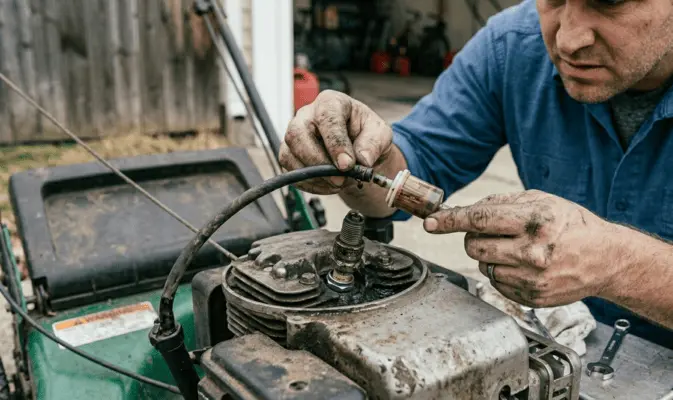
The primer bulb is the small rubber button usually found near the carburetor on push mowers. Pressing it manually injects a small shot of fuel into the carburetor to make cold starts easier. If the primer bulb is cracked, hardened, or not creating a proper vacuum, it fails to deliver fuel, and the engine struggles to start, especially on the first pull of the day.
What it looks like: You press the bulb, and it does not spring back firmly, or you can see a crack in the rubber surface. The mower might need an unusual number of pulls to start or simply refuse entirely.
How to fix it: Inspect the bulb closely for visible cracks, hardening from age, or tears. Even hairline cracks are enough to break the vacuum seal. Replacement primer bulbs are available at hardware stores and online for $3 to $10. Replacing one usually takes less than five minutes with a flathead screwdriver. When you do have a working primer bulb, press it three to five times before attempting to start the engine. More than five presses risk flooding the engine.
Cause 8: A Triggered Safety Switch
Modern lawn mowers, especially riding mowers, come loaded with safety interlock switches. These include the seat switch (which kills the engine if the operator leaves the seat on a riding mower), the blade engagement switch, the handlebar bail lever on walk-behind mowers, and the parking brake interlock. If any of these switches are faulty, stuck, or not properly engaged, the mower will not start as a built-in protection measure.
What it looks like: The engine does nothing at all, no cranking, no sputtering, complete silence. On riding mowers, you may notice the starter does not even attempt to engage.
How to fix it: Work through each safety interlock systematically. For a push mower, make sure you are holding the bail lever (the handlebar bar) firmly against the handle while pulling the cord. A half-grip will not cut it on most models. For riding mowers, confirm the seat switch is functioning (sit squarely, not perched on the edge), set the parking brake completely, and ensure the blade engagement is in the “off” position before starting. If you have confirmed all switches are correctly engaged, and the mower still will not start, one of the switches itself may have failed. Testing with a multimeter or consulting a technician is the next step. Do not bypass safety switches as a permanent solution; they exist to protect you.
Cause 9: A Flooded Engine
Engine flooding happens when too much fuel enters the combustion chamber, saturating the spark plug and making ignition impossible. It most often occurs when the mower is cranked repeatedly without starting (which forces excess fuel through the primer system), when the choke is left in the “on” position too long, or when the mower is tipped the wrong way during storage or cleaning.
What it looks like: There is a strong gasoline odour coming from the engine. The mower cranks but refuses to fire. Sometimes you can see fuel dripping from the carburetor area. The spark plug, when removed, will be visibly wet with fuel.
How to fix it: Stop trying to start it immediately. Pulling the cord repeatedly when the engine is flooded only makes things worse. Instead, remove the air filter and set the choke lever to the fully open (off) position. Allow the mower to sit undisturbed for 15 to 20 minutes. This gives the excess fuel time to evaporate. After the wait, try starting again with the choke off. If the plug is soaking wet, remove it, wipe it dry, reinstall it, and then attempt the restart. In most cases, the engine will fire on the first or second pull after this waiting period.
Cause 10: A Sheared Flywheel Key
This one is less common but important to know about. The flywheel key is a small metal piece that aligns the flywheel with the crankshaft to ensure proper ignition timing. When a mower blade strikes a hard object like a root, rock, or concrete curb, the flywheel key is designed to shear (break) intentionally to protect the crankshaft from damage. Once the key is sheared, the timing between the spark and the piston’s movement is thrown out of alignment, and the engine either won’t start or backfires badly.
What it looks like: The engine cranks, you have fuel, you have spark, but it still won’t run. You may also notice backfiring or a sharp popping sound when pulling the cord. This almost always follows an incident where the blade hit something solid.
How to fix it: You will need to access the flywheel, which requires removing the engine shroud. Inspect the flywheel key (a small rectangular piece, often aluminum). If it is sheared at an angle or visibly damaged, it must be replaced. Flywheel keys are inexpensive, usually under $5, but accessing them requires a flywheel puller tool and a basic comfort level with small engine mechanics. If you are not confident working at this level, a small engine repair shop can handle it quickly and affordably.
Quick Troubleshooting Reference Table
To make diagnosis faster, here is a simple reference based on what your mower is doing:
The engine does nothing at all when you pull the cord: Check the safety switches, bail lever, seat switch, oil level sensor, and battery (on electric-start models).
The engine cranks but does not fire: Check the spark plug, carburetor, fuel quality, fuel filter, and choke setting.
The mower starts for two seconds and immediately dies: The carburetor is almost certainly clogged or the fuel is stale.
The mower starts but runs rough and smokes: Check the air filter, oil level (overfill), and choke position.
The mower won’t start after hitting something: Check the flywheel key.
Strong gas smell with no ignition: The engine is flooded. Wait 15 to 20 minutes before trying again.
When to Call a Professional
There comes a point where DIY troubleshooting reaches its limit. Call a qualified small engine technician if you notice any of the following:
The starter rope is jammed or broken internally. The engine produces a loud knocking sound while running. You see heavy white or blue smoke, indicating oil burning. You have replaced the spark plug, cleaned the carburetor, used fresh fuel, and the mower still refuses to start. There is visible damage to the crankshaft, connecting rod, or internal engine components.
Most repair shops offer diagnostic services for $50 to $100, and straightforward jobs like carburetor rebuilds typically run between $90 and $180, including parts. Weigh that against the age and value of your mower. A machine older than 10 years with a failing engine may be a better candidate for replacement than repair.
How to Prevent Starting Problems Before They Happen
The best repair is one you never have to make. A few simple habits at the end of every mowing season will keep your machine ready to start reliably the moment you need it.
Run the fuel tank completely dry before winter storage, or add a quality fuel stabilizer to any remaining gas. Change the engine oil annually or every 50 hours of use, whichever comes first. Replace the spark plug every season. Clean or replace the air filter every 25 hours of use. Remove grass buildup from under the deck after each use, since packed clippings trap moisture and corrode metal surfaces. Store your mower in a dry, sheltered location away from extreme temperature swings.
These five habits take less than 30 minutes at the end of the season and eliminate the vast majority of spring starting problems.
Final Thoughts
A lawn mower that won’t start is genuinely frustrating, but in the majority of cases, the fix is something any homeowner can handle without specialized tools or training. Work through the causes above in order, from fuel and spark plug to the carburetor and safety switches, and you will find the problem. Brands like Briggs and Stratton, Kohler, Honda, Kawasaki, and Husqvarna all use small engines that respond to the same fundamental troubleshooting logic.
For more in-depth guides on specific mower models, maintenance schedules, and equipment comparisons, visit mowermasterpro.com, where you will find everything you need to keep your lawn looking sharp all season long.